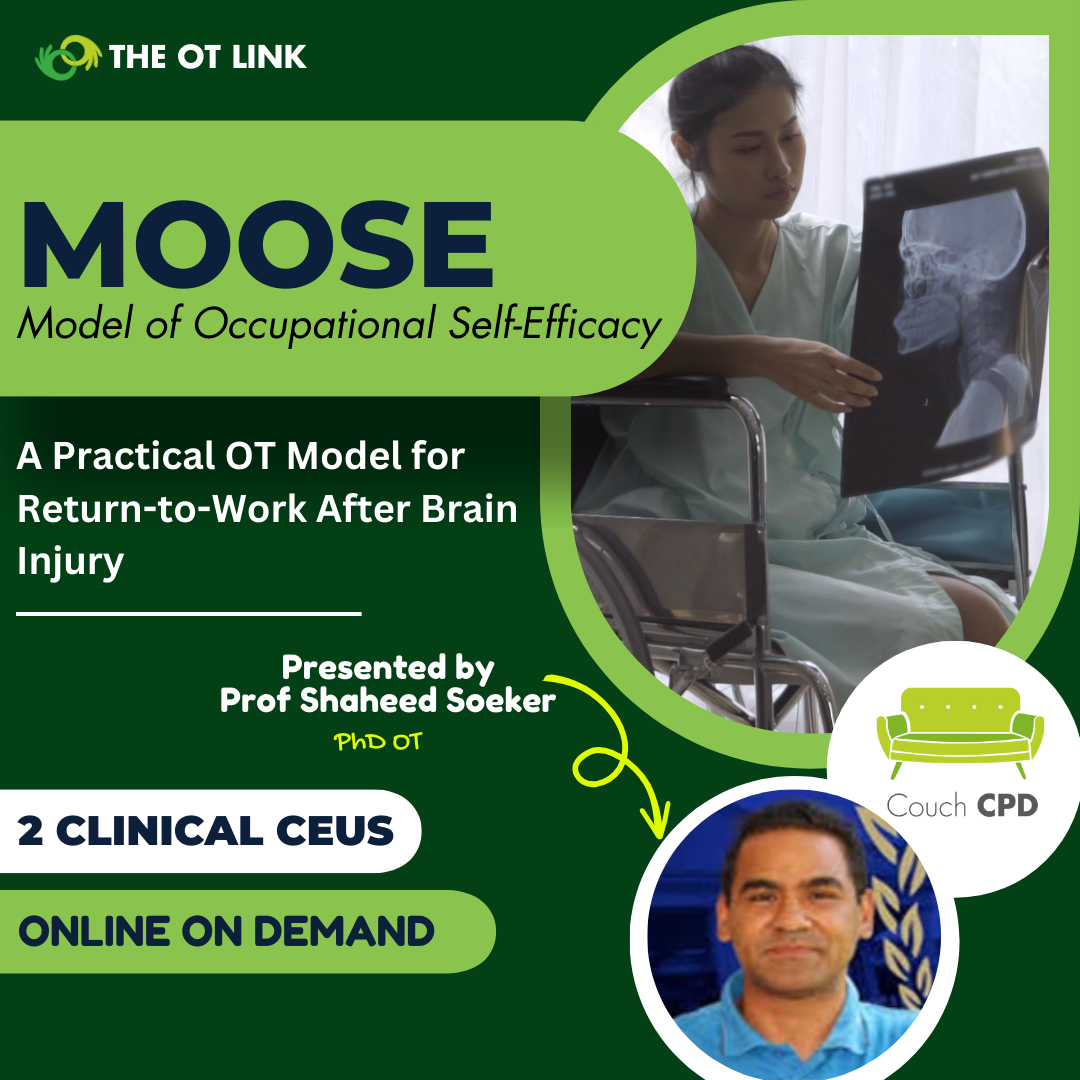
This practical course introduces the Model of Occupational Self-Efficacy (MOOSE) — a structured, client-centred approach that builds work readiness through occupational engagement and self-efficacy. Designed for occupational therapists working in vocational rehabilitation, functional capacity evaluations, medico-legal assessments, and claims settings, the course explores how MOOSE supports clear, defensible return-to-work recommendations.
Participants will review common rehabilitation models for individuals with mild to moderate traumatic brain injury (TBI), and unpack foundational principles for assessing function, work capacity, and rehabilitation potential. You’ll gain insight into the evidence and theory underpinning the MOOSE model, and learn how it enhances clinical reasoning in assessment, goal-setting, return to work recommendations and intervention planning.
Real-world case studies and clinical scenarios will deepen your understanding and support immediate application in your OT practice — whether you’re treating, evaluating, assessing or advising on return-to-work outcomes.
 Shaheed Soeker (PhD) is a Professor and Chairperson of the Department of Occupational Therapy at the University of the Western Cape. He has extensive experience in the area of vocational rehabilitation, claims assessing and paediatric occupational therapy. He has published several articles and chapters in international peer reviewed journals and books. Dr Soeker has been awarded an NRF (C3) rating in January 2021 and has been called upon to be a keynote speaker at various international conferences.
Prof Soeker developed the The Model of Occupational Self Efficacy: A model for returning
individuals with mild to moderate traumatic brain injury to work, during his PhD.
Shaheed Soeker (PhD) is a Professor and Chairperson of the Department of Occupational Therapy at the University of the Western Cape. He has extensive experience in the area of vocational rehabilitation, claims assessing and paediatric occupational therapy. He has published several articles and chapters in international peer reviewed journals and books. Dr Soeker has been awarded an NRF (C3) rating in January 2021 and has been called upon to be a keynote speaker at various international conferences.
Prof Soeker developed the The Model of Occupational Self Efficacy: A model for returning
individuals with mild to moderate traumatic brain injury to work, during his PhD.